July was an exciting month for the team at Minimal! For starters, we’re now fully open source!
We’ve also added a ton of new things, like a better way to boot on macOS, 80 new packages, Sessions and loadouts, and more! Here’s a quick look at everything we did in July.
A brand new boot for macOS
Our vision with Minimal has always been for it to work on every machine. In the early stages of building, Minimal was a Linux runtime that used Apple container runtime for operation on macOS. This was something we changed in July so workflow and performance would be truly identical.
On Linux, minimald starts and supervises the sandboxes. On macOS, minvmd brings up a Linux microVM via libkrun (HVF-backed) as the platform’s exclusive session backend. From there, minimald runs inside that microVM and is reachable over vsock. These changes allow our macOS sessions to run on par with their Linux counterparts while also simplifying the codebase. Additionally, it’s the first step towards enabling remote access of Minimal’s sandboxes!
New packages, better organized
Minimal’s core is our package library, which is why it’s important for that to be both thorough and accessible. Across the month, we added roughly 80 new packages, including:
Developer tooling: neovim, lazygit, ruff, wrangler, zola, esbuild, eslint, lazydocker, hyperfine, tokei, tealdeer, and more.
Languages and crypto: OCaml (plus the full ecosystem: dune, menhir, ocamlfind, ppxlib, etc.), Lean, Tamarin Prover, Maude, and more.
Security tooling: gitleaks, sops, restic, zizmor, and govulncheck.
Packages are updated on our end to ensure all builders have access to the best tools. Notable version bumps include:
- Chromium 147 → 151
- fish 4.5 → 4.8.1
- NumPy 2.3.5 → 2.5.1
- Python 3.14.5 → 3.14.6
- Rust 1.95 → 1.97.1
- SQLite 3.50.4 → 3.53.3
- tmux 3.6a → 3.7
A nicer package catalog
While all packages can be viewed on our GitHub, we also added a new resource to explore them directly on our website, https://minimal.dev/pkgs. In addition to browsing through the options, this resource can be used to:
- Compare commits to see additions, removals, version bumps, and advisory-count deltas.
- See security advisories and subscribe to the Atom feed.
- Check out the SVG advisory badges, which can be embedded into READMEs with
/api/pkgs/<name>/badge.svg
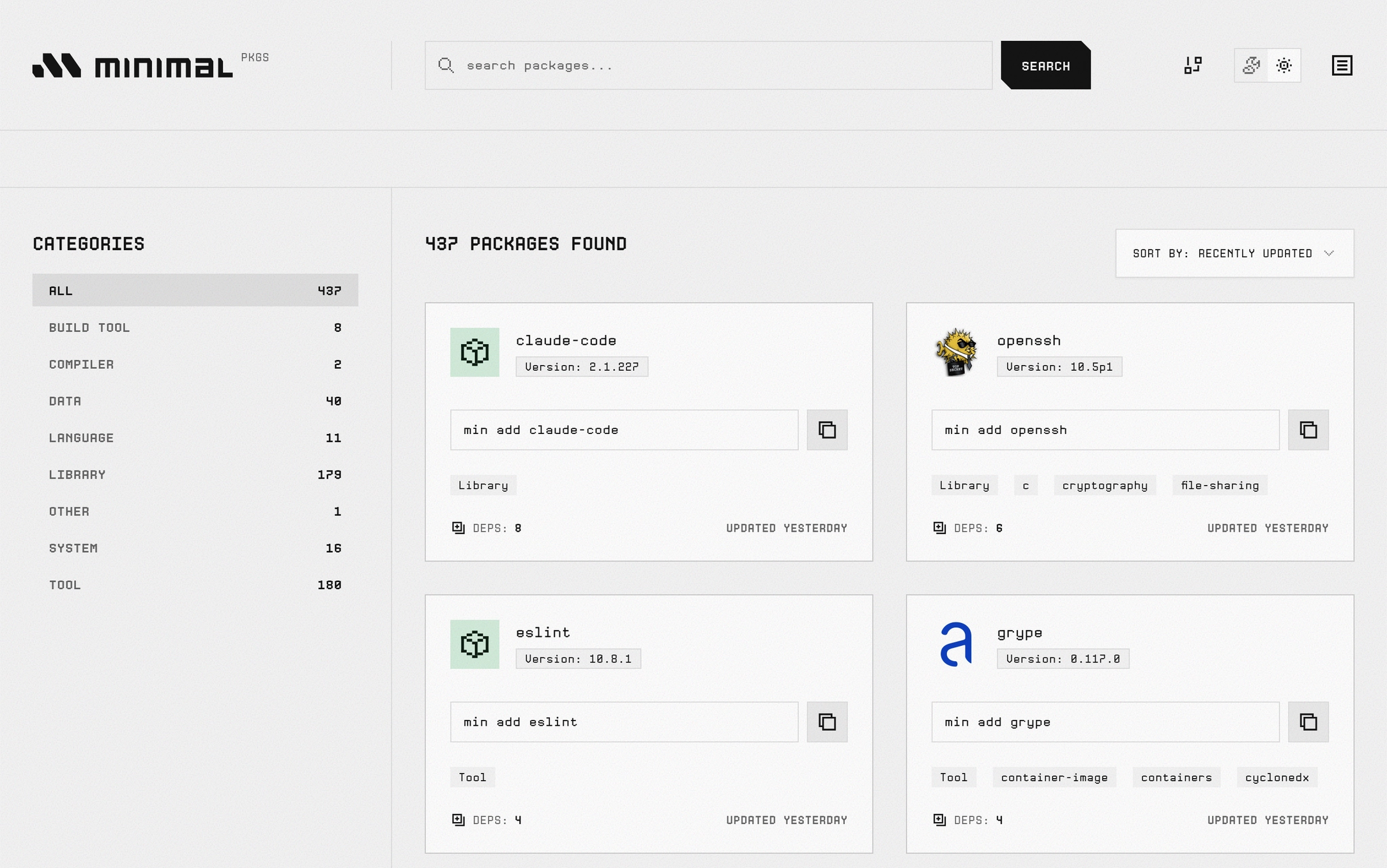
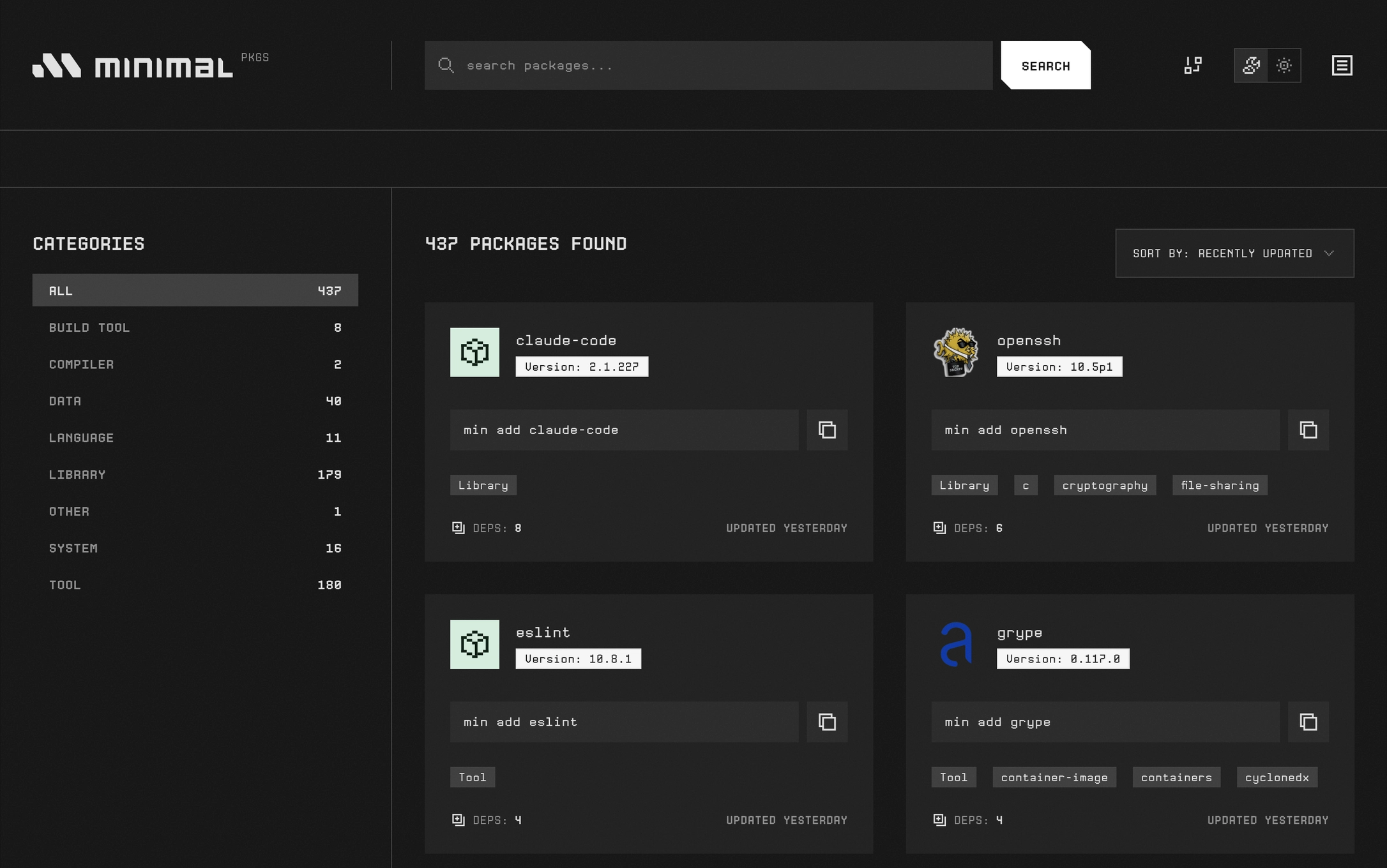
Minimal’s new package catalog
Keeping things agent-friendly
Our team is trying to keep things straightforward for the agents that end up on our doorstep. We’ve created resources like a specific MCP server at /api/mcp that shows the package catalog as agent tools, an OpenAPI 3.1 document, and an /llms.txt index with per-package markdown mirrors at /pkgs/<name>.md.
Sessions and loadouts: contextual, durable, pre-equipped
Last on the list but biggest for our users are Sessions and loadouts! Robust, isolated sandboxes that function alongside our more transitory Tasks. Now, your working environments are stateful and natively aware of important context, like your Git worktrees, file patches, and tool configurations.
Sessions come with a slew of new functions–like create, destroy, attach/detach, and more–along with loadouts. These pre-configured workspaces are equipped with your preferred tools and don’t affect project level dependencies. They’re included in Session composition along with packages and policies, which now persist across daemon restarts.
Learn more in the docs on Sessions and loadouts.
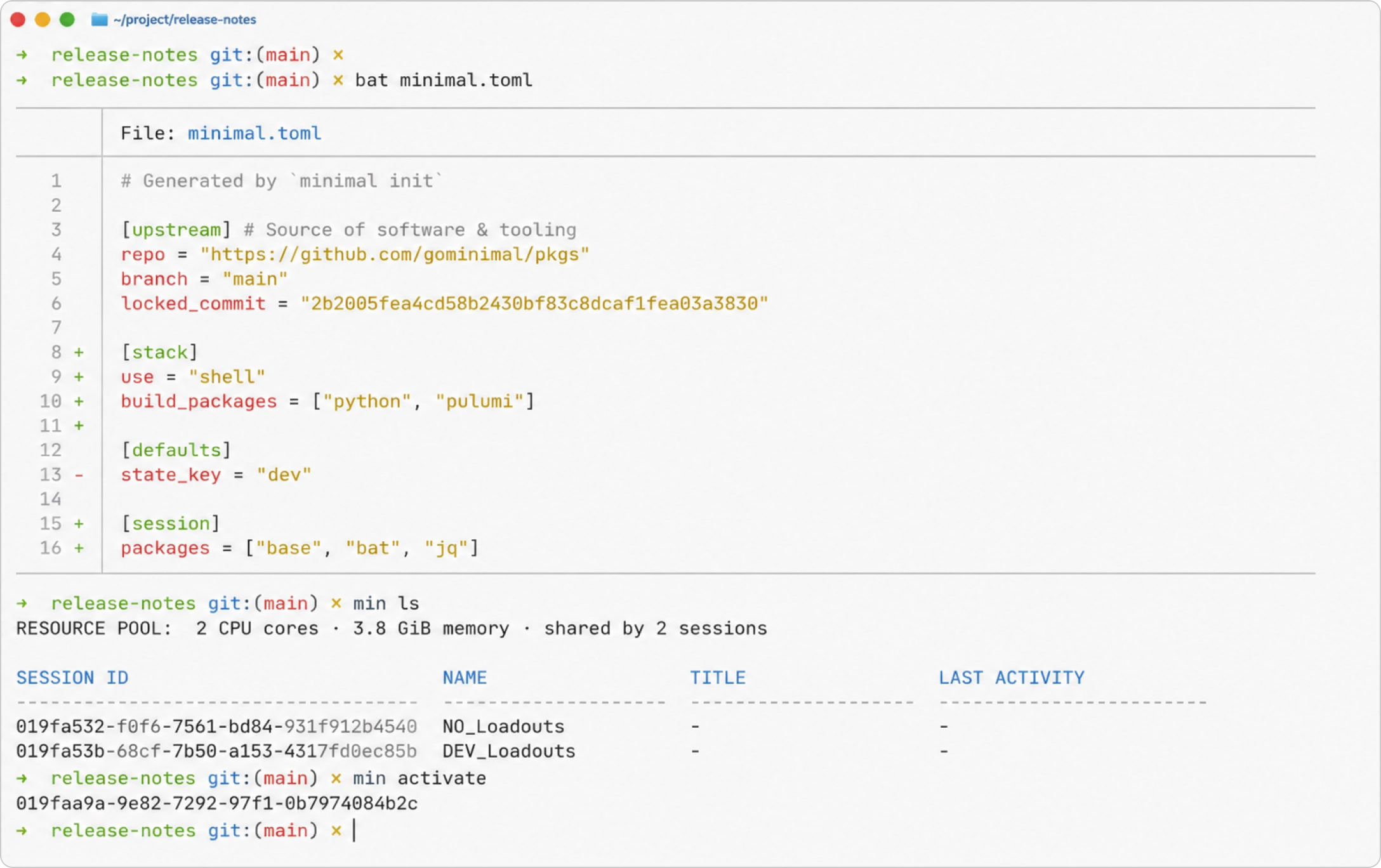
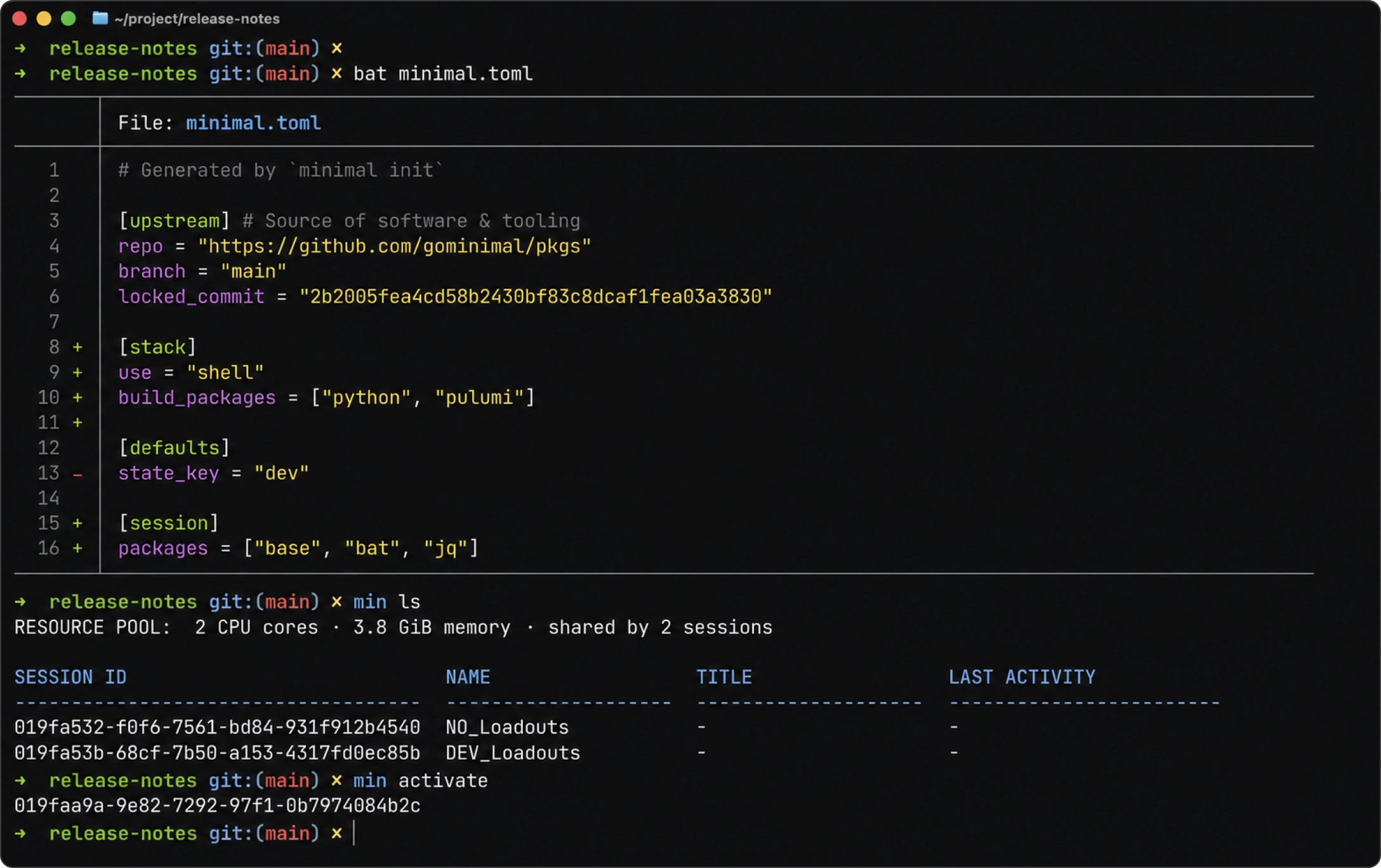
An overview of the available Sessions, configuration, and Session creation.
Let’s keep it going
Our team is really proud of all the work we accomplished in July and we’re excited to continue making Minimal the best it can be. We would love for you to be a part of that!
Minimal’s stable release is available now for download.
We’re always looking for builders who can push us forward! We hope that you’ll join our Discord community to ask questions and provide feedback. Here, you’ll also see each Release as it goes live every Friday.